
What is spec-driven development?
Spec-driven development (SDD) is a software methodology in which a detailed specification of implementation details is authored and agreed upon before development begins.
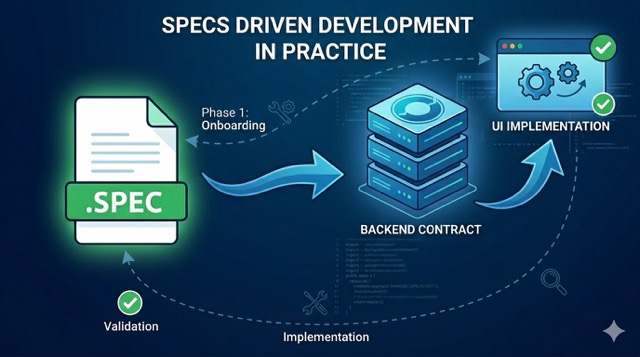
Spec-driven development, defined
Spec-driven development (SDD) is a software methodology in which a detailed specification of implementation details is authored and agreed upon before development begins. In other words, it serves as a single source of truth for what to build and how to build it.
With the accessibility of AI tools and coding assistants, like Microsoft’s GitHub Copilot, Anthropic’s Claude Code or IBM’s Bob, the barrier to entry for code generation has lowered. An LLM-powered AI agent that uses sophisticated AI models, can run a series of iterative tasks in real-time at any moment, all with a single natural language prompt from the user.
For software development, this means that we can optimize and automate the development workflow for building prototypes, new features, unit tests and others. It has never been easier to generate code. However, there is a slippery slope vibe coders should be aware of: AI is only as good as the instructions it receives.
The rise of technical debt: A scenario
You have likely seen technical debt in the real-world, perhaps without even realizing it. Technical debt predates vibe coding and has been part of software development for decades, accruing when shortcuts are taken in the name of speed. However, vibe coding accelerates technical debt by making it easy to generate large amounts of code without fully understanding or validating it. Perhaps there is pressure to ship quickly, or the vibe coder simply does not have the technical background to halt technical debt before it starts.
Technical debt in AI-assisted development can take several forms:
- Context drift occurs when a bug fix in one area inadvertently breaks functionality in another, a symptom of code that was generated without a complete understanding of the broader system.
- Fragmentation is another common manifestation, where newly generated features fail to align with the existing architectural conventions, gradually eroding the consistency and maintainability of the codebase.
- There is also an operational cost to consider. Without a clear specification to anchor the generation process, developers can find themselves caught in lengthy prompting cycles. This approach can consume thousands of tokens to resolve errors that a well-defined spec would have prevented entirely.
Imagine a scenario many developers across the industry know well. You have been working on a new feature for several days or weeks, nearly ready to ship. Then, under the pressure of an approaching deadline, you rush the final tweaks through a series of AI-prompted changes.
The functions of the generated code, whether written in Python or another language, might look fine from the user’s perspective. However, in the process, several vulnerabilities have been exposed, dependency conflicts introduced and edge case handling and testing forgotten entirely.
A formal specification established upfront gives the team a shared source of truth to govern every phase of the software development lifecycle (SDLC), regardless of who was writing the code.
The spectrum of specification
There are several approaches and templates to spec-driven development with varying levels of spec maintenance and different tradeoffs. Rather than a strict “better” progression, the right choice depends on your codebase, team and problem space. Consider your team’s needs and constraints before selecting one.
Spec-first development
In spec-first development, specification is written before any code is generated, in the form of a user story, acceptance criteria or a formal requirements document. When the initial clarity is provided and the code is generated, the spec is not necessarily maintained. The specification might grow outdated as the software evolves. Its primary purpose was to provide initial clarity without continued spec maintenance. This aspect is considered the “entry point to SDD.” 1
Spec-anchored development
In spec-anchored development, the specification evolves alongside the software. As requirements change and features are added, the spec is updated to reflect the current state of the system. This is especially useful for projects serving larger initiatives.
Automated tests serve as the bridge between documentation and implementation, often integrated into a CI/CD pipeline to ensure the two remain synchronized and executable throughout the development lifecycle. This balance of structure and flexibility makes spec-anchored development a practical and scalable approach for most engineering teams.1
Spec-as-source development
On the furthest end of the spectrum is spec-as-source development—the most AI-first form. In spec-as-source development, changes in the spec automatically trigger changes in the code. No human is ever directly refactoring the code.
This level of specification authority demands a high degree of confidence in the quality and consistency of the AI code generation pipeline, which remains inherently nondeterministic today. In practice, that means it can be less rigorous without strong human oversight. Before adopting this approach, teams should carefully evaluate the maturity of their tech stack and spec kit, the criticality of the systems involved and their capacity to validate AI-generated output.1
Hybrid approaches
In practice, many teams adopt hybrid approaches:
- Treating specs as stackable versioned artifacts, like architecture decision records (ADRs), rather than always keeping them fully up to date.
- Using external systems (for example, issue trackers) as the source of truth to introduce intentional separation.
- Avoiding heavy automation in high-complexity or community-driven projects where tight control over changes is critical.
Each approach has strengths and limitations; context matters more than strict adherence to any one model.